

the headline: sep/oct 2026
Hiking to High Ground: Coaching Is Healthcare

The field of coaching in healthcare (professional health and well-being coaching) has been hiking up the healthcare mountain, in my case for 25 years (after my two-week trek in the Himalayas in 1999). High ground is where health and well-being coaching lives inside healthcare as an evidence-based, reimbursable, professionally credentialed service that helps people do what healthcare isn't designed to do: change for good - positive and sustainable.
CMS comments on the national payment policy for health and well-being coaching services were due September 14th at 11:59 PM.
HUGE THANKS to the multitude of coaches, physicians, and organizations who submitted comments supporting the policy and the refinements needed for viability. You can read the comments here: https://www.regulations.gov/docket/CMS-2026-2377 (search for well-being coach)
Yesterday I submitted sixty five pages of comments to CMS on the proposed 2027 Physician Fee Schedule. Here is the core proposal. It is the most consequential policy moment in the history of this field, and here is what it means and what matters most.
High ground
The high ground is a simple claim with enormous implications: people can change. Not just manage their conditions. Not just comply with clinical recommendations. Truly change their behaviors and mindset, their relationship to their health, and over time, their health itself. Eighty percent of Medicare beneficiaries are not engaged in four of the five top lifestyle behaviors. Providers are not trained or paid to help them. Coaching is the profession, the professional intervention that closes that gap.
CMS's proposed rule would establish national payment for health and well-being coaching services for the first time. That is the crossing of a threshold this profession has been building toward for a generation.
What the submission argues
The comments address five things that the CMS policy needs to reach high ground:
1. G-codes, not temporary codes.
Since January 2020, health and well-being coaching services have been tracked using Category III CPT codes — temporary codes designed for emerging technologies not yet supported by a full evidence base. That era is over. The evidence base is established. The profession is credentialed. The workforce exists.
What coaching needs now is the stability of permanent Level II HCPCS G-codes that signal to medical practices, health systems, hospital outpatient departments, rural health clinics, and community organizations that this is an evidence-based service worth building infrastructure around: hiring coaches, integrating them into care teams, building scheduling and documentation and billing systems.
Three proposed G-codes would replace the existing CPT codes and correct language that will cause billing obstacles:
— GXXX1 replaces 0591T: Health and well-being coaching; individual, assessment and planning, at least 60 minutes by a qualified professional coach. The revision removes "initial" and "face-to-face," adds "and planning," and specifies "at least 60 minutes" — clarifying that this comprehensive service includes goal-setting and planning, is not limited to a first visit, and is fully available via telehealth including audio-only delivery.
— GXXX2 replaces 0592T: Health and well-being coaching; Individual, follow-up session, at least 30 minutes by a qualified professional coach. The revision adds "by a qualified professional coach" ensuring every follow-up session is delivered by a credentialed professional.
— GXXX3 replaces 0593T: Health and well-being coaching, group (2 or more individuals), each 30 minutes by a qualified professional coach. The revision changes "at least 30 minutes" to "each 30 minutes," enabling billing in 30-minute increments and allowing two increments for the standard 60-minute group session.
Each descriptor adds "by a qualified professional coach" - four words that do significant policy work. They embed the professional identity directly into the payment architecture, so that every billing event affirms that coaching is a defined, credentialed discipline with its own competencies, training, examination, and standards. It also sends a signal to medical practices to select coaches who identify as professional coaches, not other health professionals with training in coaching skills.
2. Fair valuation.
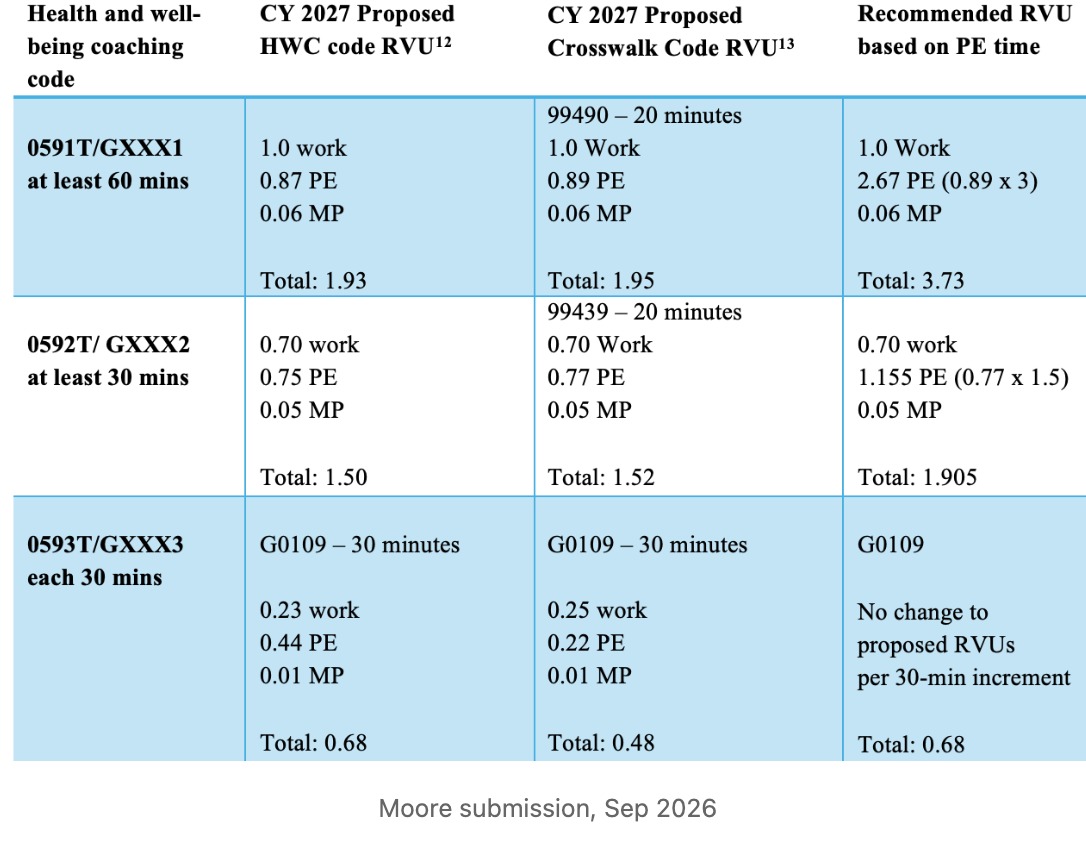
The proposed rates undervalue coaching relative to the clinical labor the service requires. At proposed values, a 60-minute assessment and planning session yields 1.93 total RVUs. (One RVU is valued at ~$33.) Sixty minutes of chronic care management — the comparator CMS used — yields 4.99 total RVUs. A physician practice choosing how to deploy a finite clinical staff hour will choose chronic care management. That defeats the policy before it begins.
The submission recommends minute-for-minute parity with the CCM comparator codes, producing a total RVU of 3.73 for the 60-minute session and 1.905 for the 30-minute follow-up. This is not an argument for premium valuation — it is an argument that payment should track the resources a service consumes, which is CMS's own standard.
3. General supervision.
The standard of care is general supervision — a qualified professional coach working independently, documenting in the medical record, collaborating with the care team. The Veterans Health Administration has delivered 1.26 million coaching sessions to nearly 300,000 Veterans at 105 sites under general supervision since 2017. Direct supervision would be a step backward nationwide, incompatible with telehealth delivery, and without clinical justification.
4. Four criteria for recognizing national credentialing organizations for qualified professional health and well-being coaches.
A certification in health and well-being coaching delivered by a national credentialing organization must meet four conditions developed by NBHWC as the standards supporting the CMS proposed policy:
independent of any other professional license or degree - coaching standards stand on their own
built on robust coaching competencies including those included in the code description
supported by an approved/accredited training program that delivers the coaching competences in 2. and assesses practical skills
verified by a national certification examination meeting health-professions psychometric standards and providing governance of safe, ethical, and effective practice.
These criteria protect patients and protect the profession. They give CMS a defensible framework that any qualifying organization can meet — and any organizations not yet meeting the standards have a clear pathway to do so.
Why these four steps bring coaching to high ground in healthcare
For coaching to thrive inside healthcare, it needs what every other healthcare profession has: coding that identifies the service as unique, valuation that makes delivery viable, supervision standards that reflect how the service is efficiently and cost effectively delivered, and credentialing standards that protect patients and promote professional dedication to continuous improvement in skills and outcomes.
Getting those four things right not only opens a payment pathway. It establishes coaching as a profession that healthcare can rely on — with the infrastructure, accountability, and standards that integration requires, delivering the outcomes we all aspire for.
The evidence base is established. The credentialing infrastructure exists. A workforce of 13,000 NBHWC certified coaches is ready. What remains is accurate coding, fair valuation, general supervision, and credentialing standards that make this policy deployable at scale.
The high ground is within sight and within reach. We can change.
Upward!

Comments